Shopping Cart
No item in your cart!
RM0.00
View Cart


Liver problems do not usually come with a warning. There is no pain, no obvious signal. You feel completely fine. And yet, a condition can be developing inside your liver for years without any outward sign at all.
For many Malaysians, the first clue comes not from a symptom but from an unexpected result on a routine blood test done for an entirely different reason, such as a health screening at work or a diabetes check.
By the time visible signs appear, such as skin or eyes turning yellowish, persistent tiredness, or swelling in the belly, a liver condition may have already been progressing for some time.
This is why knowing when liver health checks in Malaysia make sense matters. Catching a problem early means more can be done about it.

The liver is a hard-working organ. It processes the food you eat, filters your blood, helps your blood clot when you get a cut, and breaks down medications and alcohol. The thing is, it keeps doing all of this even when part of it is damaged.
That ability to carry on quietly is exactly what makes liver disease easy to miss. The liver compensates and picks up the slack, so you feel nothing while damage slowly builds. By the time symptoms appear, conditions like cirrhosis (permanent scarring of the liver) can already be present.
Because the liver keeps working even when it is damaged, symptoms are not a reliable signal that something is wrong. A check gives you a clearer picture than waiting.
Fatty liver disease is a frequent finding during health screenings in Malaysia. It means fat has built up inside the liver cells. This can happen gradually without you ever knowing. Research estimates fatty liver affects around 30% of people globally, and Malaysia is among the countries with higher rates in the region. A significant portion of those affected have no idea.
Getting a liver check is not just something for people with a history of heavy drinking or hepatitis. Several conditions that are widespread in Malaysia are directly linked to liver problems.
If you have type 2 diabetes or have been told your blood sugar is on the high side, your liver is worth checking. High blood sugar and a condition called insulin resistance (where your body stops responding well to insulin) make it easier for fat to build up in the liver.
Carrying extra weight, especially around the abdomen, is one of the biggest risk factors for fatty liver. The National Health and Morbidity Survey 2023 found that 54.4% of Malaysian adults are overweight or obese, which gives a sense of how widespread this risk is across the population.
If your blood test has flagged high cholesterol or triglycerides (a type of fat in your blood), these can go hand-in-hand with changes in the liver that are worth following up on, especially alongside other risk factors.
If hepatitis B, cirrhosis, or liver cancer runs in your family, your own risk is higher. Hepatitis B is well-established in Malaysia, and chronic infection can slowly damage the liver over decades without producing any early symptoms.
Some medications, including certain cholesterol-lowering drugs, and herbal supplements can affect the liver when taken over a long period. If you have been on regular medication for years, it is worth asking your doctor whether periodic liver monitoring makes sense.
If any of these apply to you, speaking with a hepatology (liver) specialist is a reasonable next step.
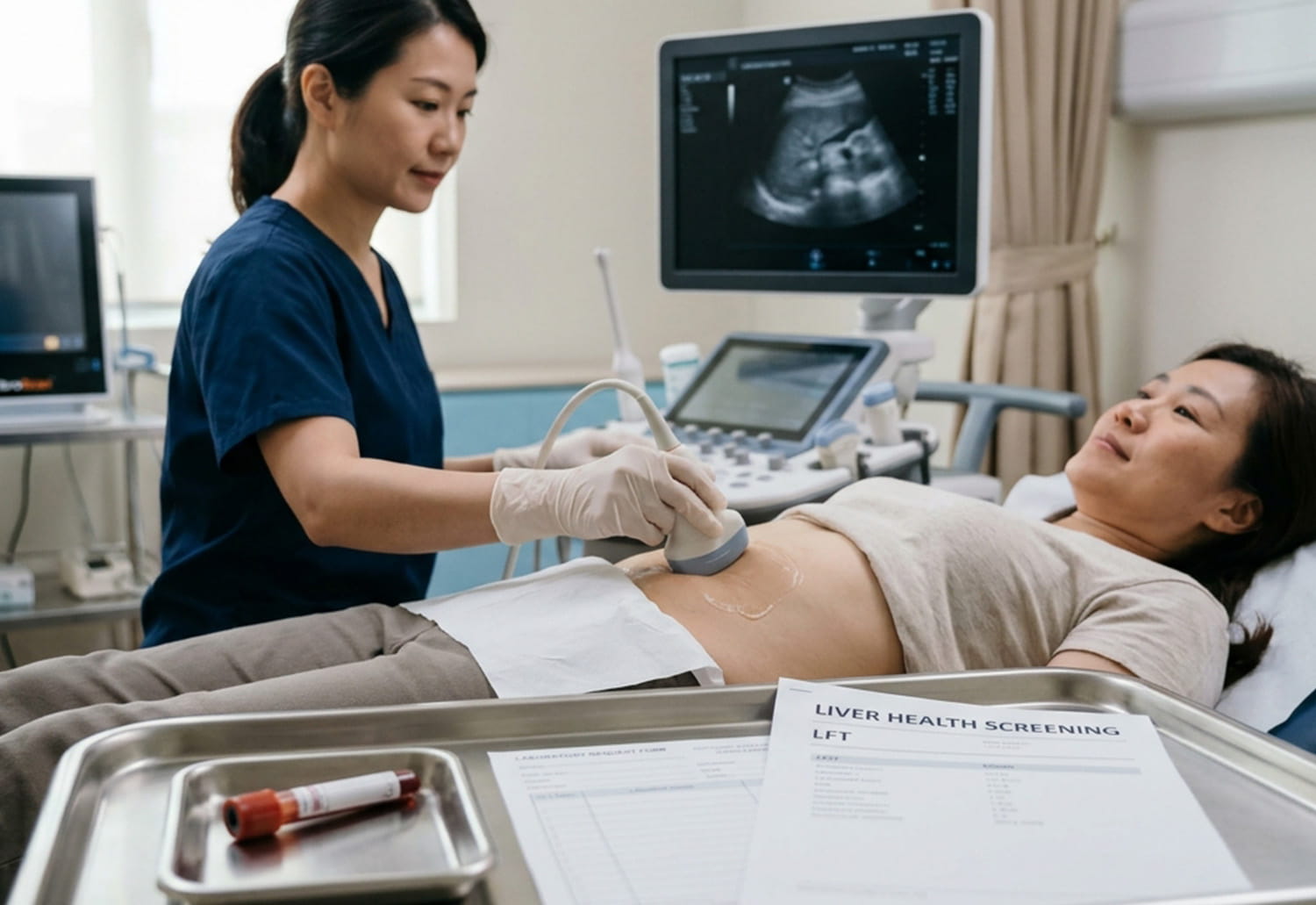
A liver health check in Malaysia usually starts with a blood test called a liver function test, or LFT. This measures certain enzymes and proteins in your blood that show how your liver is working. If enzymes called ALT or AST come back higher than normal, it is a sign that there may be some inflammation or damage in the liver.
One blood test does not tell the full story, though. Enzyme levels can look completely normal even when changes are already happening inside the liver. This is why a proper liver screening usually includes an imaging scan as well.
Here is what a liver assessment may involve:
|
Test |
What It Does |
|
Liver function test (LFT) |
Blood test measuring liver enzymes; the standard first step |
|
Abdominal ultrasound |
Scan that checks for fatty changes, swelling, or anything unusual |
|
FibroScan |
Painless scan that measures liver stiffness; higher stiffness can point to scarring |
|
Biopsy |
A small tissue sample taken when scans are unclear, or results are significantly abnormal |
Cengild's health screening packages include ultrasound alongside blood tests as part of a combined check.
A blood test is a useful starting point, but a thorough liver health check also includes a scan and a look at your full medical history to put the picture together properly.
If a blood test comes back with raised liver enzyme levels, it does not automatically mean something serious is happening. But it does mean the result is worth looking into rather than leaving it alone.
If your GP flags an abnormal result, asking for a referral to a gastroenterology hepatology specialist is the right move. The specialist will look at which enzymes are raised, by how much, and your medical background before deciding what to do next.
Raised liver enzymes can come from several things: fatty liver, certain medications, thyroid issues, or in some cases, viral hepatitis or autoimmune liver disease (where the immune system mistakenly attacks the liver). Not every abnormal reading needs treatment straight away, but figuring out what is behind it requires a proper assessment, not just a "wait and see."
Fatty liver can range from mild to more serious, depending on how far it has progressed.
At the mild end is simple fatty liver (doctors call this steatosis): fat builds up in the liver cells, but there is no significant inflammation or damage yet. If it progresses, a more serious form called NASH can develop. NASH stands for non-alcoholic steatohepatitis, which means inflammation has set in alongside the fat, and the liver is starting to scar. If NASH is left unchecked, that scarring can worsen into cirrhosis or, in some cases, liver cancer.
The tricky part is that you cannot tell from how you feel which stage you are at. Neither gives you any clear warning signs. That is exactly why getting checked early matters.
The earlier fatty liver is found, the more you can do about it. In the earlier stages, real improvement is possible through lifestyle changes, such as losing some weight and cutting back on white rice, sugary drinks, and processed foods. Once significant scarring has set in, those options become far more limited.

Liver health checks in Malaysia start with a blood test to check enzyme levels and liver function. This is usually followed by an ultrasound scan to look at the liver itself. In some cases, a FibroScan or tissue sample may be recommended. A hepatology specialist reviews everything together with your medical history to decide whether any follow-up is needed.
Yes, feeling well does not rule out a liver problem. Fatty liver produces no symptoms in the early stages and is often discovered only after an abnormal blood test or a scan done for an unrelated reason. If you have any of the risk factors covered in this article, such as type 2 diabetes, being overweight, or high cholesterol, a check is worth having even when you feel perfectly fine.
If your GP has flagged abnormal liver enzyme levels on a blood test, or if a scan has picked up something worth investigating, the next step is a referral to a gastroenterology hepatology specialist. A specialist focuses specifically on the liver, gallbladder, bile ducts, and pancreas, and can order the right combination of tests, including FibroScan, to understand what is actually going on rather than leaving an abnormal result unresolved.
It depends on your risk profile. If you have risk factors like obesity, type 2 diabetes, or chronic hepatitis B, it is reasonable to get checked from your 30s or 40s onwards. If you do not have identified risk factors, starting with a liver function test from your 40s is a practical approach.
Yes, it makes a significant difference. In the early stages, fatty liver can improve with lifestyle changes such as losing weight and cutting back on refined carbohydrates and sugary drinks. Once significant scarring has developed, those changes become much harder to benefit from. Getting liver health checks in Malaysia before symptoms appear is exactly what gives you more options rather than fewer.
Knowing when to consider a liver health check in Malaysia comes down to this: the liver rarely gives warning signs, but the risk factors are well-established, and the tests are straightforward. If you have type 2 diabetes, carry extra weight, or have ever had an abnormal blood result, those are the clearest reasons to get checked before any symptom appears. A liver function test and an ultrasound can already tell you whether something is worth following up on, and fatty liver caught early leaves you with real options that shrink once significant scarring is in place. The liver and digestive health team at Cengild provides specialist liver assessment in Bangsar South, Kuala Lumpur. Speak with a specialist about where your liver health stands.
This article is for general educational purposes only and does not constitute medical advice. Individual outcomes vary. Consult a qualified specialist before making any healthcare decisions.